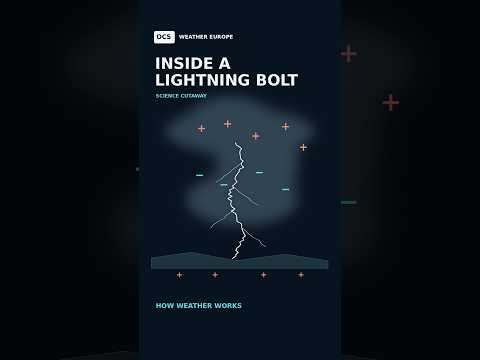
Electricity begins with a moving cloud
A lightning flash can begin with tiny collisions far above the ground. Inside a thunderstorm, small ice particles collide with graupel: ice pellets growing as they collect supercooled droplets. Those collisions can transfer charge. As rising air carries the lighter particles differently from the heavier ones, regions of electrical charge become separated.
The familiar positive-above, negative-below picture is a useful starting point, but a real storm can contain a more complicated arrangement. The film follows one common route through that complexity: a negative cloud-to-ground flash.
The flash has more than one direction
A stepped leader advances towards the surface in branches. Near the ground, an upward streamer can connect with it, completing a conductive path. The bright return stroke then propagates up that path. What appears to be one instantaneous bolt contains stages too fast for our eyes to separate.
Thunder is the sound of air responding to the lightning channel’s intense heating and rapid expansion. Different parts of that long channel reach our ears at different times, helping turn a sharp crack into a rumble. Most lightning stays within clouds, so a ground strike is only one part of the wider electrical story.
Sources & further reading
Independent background for the ideas explored on this page.

